Healthcare AI literacy

Make AI understandableacross healthcare.

Give patients, the healthcare workforce, leaders, and governance teams a shared way to understand AI in healthcare.

The investment question

AI investment reaches its value through people.

People need to understand how to:

  • Choose the right tasks.
  • Protect information.
  • Question an output.
  • Connect it to a safe workflow.

The preparation gap

Adoption is here. Preparation still has room to grow.

Healthcare organizations have AI in active use. Governance maturity and formal training still trail the work, while physicians are asking for deeper education.

National hospital survey

71%

AI is already embedded in hospital work.

Non-federal acute care hospitals reporting predictive AI integrated with the EHR in 2024, up from 66% in 2023.

The workforce is already meeting AI through risk scores, scheduling, billing, follow-up, and care workflows.

ASTP/ONC Data Brief No. 80, 2025
Physician survey

92%

Physicians are asking for more education.

In a survey of 1,692 U.S. physicians, 92% wanted more AI education and training. Twenty-seven percent had received none.

Among physicians who had received training, 11% described the amount as extensive. Exposure has moved ahead of depth.

American Medical Association, 2026

Health AI leadership survey

18%

Mature governance remains rare.

Eighteen percent of surveyed healthcare organizations reported a mature AI governance program and AI strategy, while 84% had formed a committee.

A committee creates a place to meet. Literacy helps approved use, escalation, monitoring, and accountability reach the daily work.

CHIME Foundation / Censinet, 2025

Healthcare professional survey

17%

Unauthorized AI use is already visible.

Seventeen percent of healthcare professionals surveyed admitted to using unauthorized AI tools at work.

People need a clear way to recognize approved tools, protect health information, and find a sanctioned path for the task in front of them.

Wolters Kluwer Health, 2025

Workforce training signal

74% / 33%

Use has moved far ahead of formal training.

Seventy-four percent of full-time workers surveyed said they use AI at work. One-third reported receiving formal AI training.

The cross-industry gap matters in healthcare, where AI-assisted work can touch privacy, documentation, access, and patient decisions.

Clutch survey via Lifewire, 2025

Read a current healthcare workflow

A clear note can still miss what matters.

Ambient scribes turn patient-clinician conversations into proposed documentation. Review starts with knowing that the note is a generated draft.

A 2026 Veterans Health Administration simulation tested two ambient-scribe systems across four specialties. Clinicians rated average note quality 36.2 out of 50. Notes scored highest for succinctness and lowest for thoroughness.

JAMA Network Open, 2026

Training example: ambient documentation

AI-generated note: concise and ready for review.
The system turned a clinical conversation into a draft. The clinician checks who said what, which details were left out, and whether the assessment and plan match the visit before signing.

The study included encounters with translators, family members, and background noise. Those conditions make source and speaker awareness part of the review.

What changed between the conversation and the record?

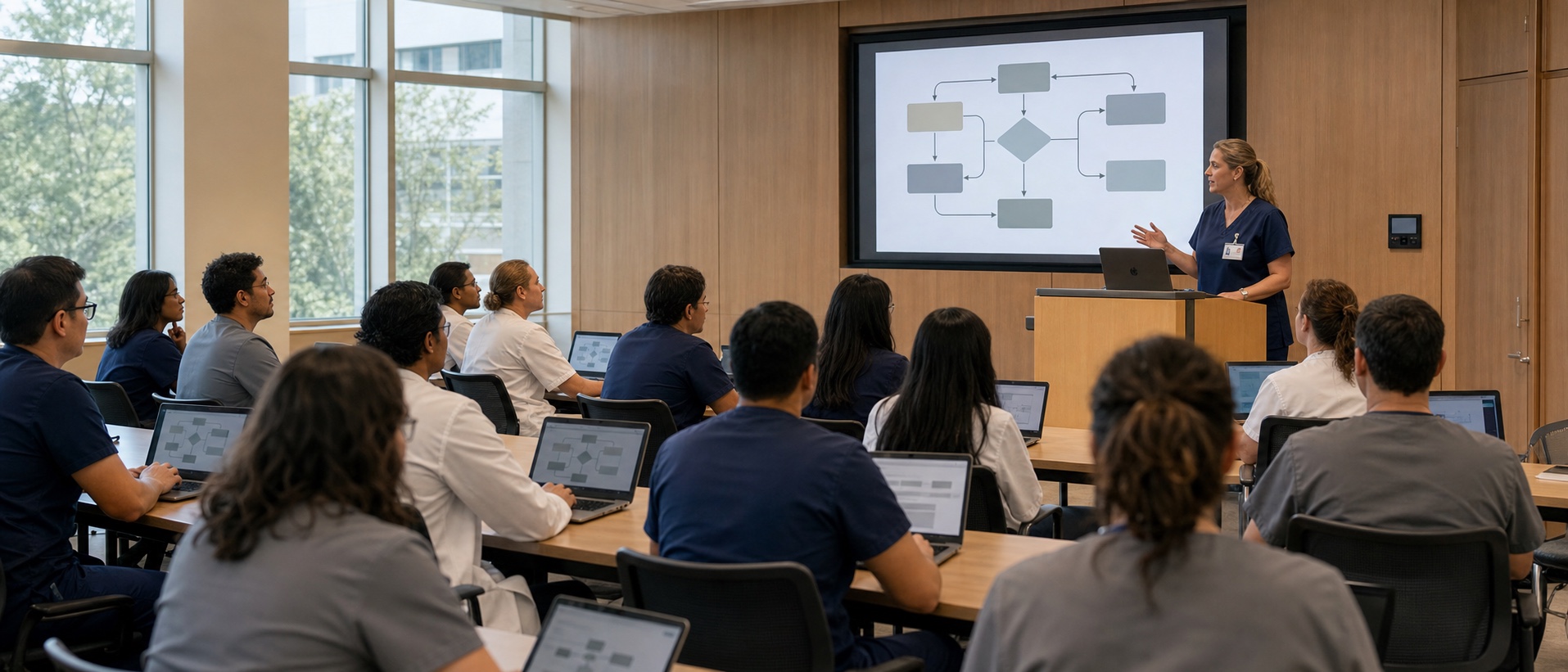
Healthcare professionals at laptops face an instructor teaching about AI from a classroom podium.
Shared learning gives care teams, leaders, and governance groups the same questions to bring back to the work.

From policy to practice

Build literacy as a working system.

A working literacy program connects learning, approved use, and measurable improvement. Each part keeps governance close to the decisions people make.

Governance runs through every stage.Approved use, ownership, monitoring, and escalation stay visible.
  1. Educate by role and depth.

    Give each role a shared foundation, then practice with the notes, prompts, tools, patient communication, and decisions they encounter.

  2. Enable safe use in the workflow.

    Connect approved tools to privacy guidance, a clear intake path, review expectations, and a sanctioned alternative when a tool falls outside policy.

  3. Empower people to improve the work.

    Use feedback, monitoring, and workflow outcomes to improve local practice, refresh learning, and show where AI creates durable value.

Explore the training

Open the areas that matter to your teams.

Start with a shared foundation, then choose the role, depth, and healthcare decisions that matter. Select an area to see examples of what people learn and practice.

Visit the catalog destination
Understand what the system is doing

Build a working vocabulary for the types of AI already appearing across healthcare and how each type produces an output.

  • Predictive, generative, and agentic AI
  • How models learn and produce answers
  • Why confident output can still be wrong
Use AI safely in daily work

Practice the decisions that protect patients, health information, and the people using AI-assisted tools.

  • Approved, restricted, and unauthorized tools
  • Health information in prompts, uploads, and transcripts
  • Hallucination, bias, overreliance, and escalation
Practice with healthcare workflows

Connect the learning to real work so each role knows what to check before an AI-assisted output moves forward.

  • Ambient notes and patient messages
  • Risk scores, scheduling, coding, and administrative work
  • Role-based review and human responsibility
Lead and govern responsible use

Give leaders and governance teams a common way to evaluate tools, assign ownership, and keep learning current after deployment.

  • Intake, approval, and the AI inventory
  • Vendor evaluation and local validation
  • Monitoring, incident response, and leadership reporting

One language around the decision

Patients ask. Clinicians check. Leaders evaluate. Governance owns the next review.

Each role needs different depth. Everyone benefits from knowing how the pieces connect.

Start with one real use case

Build learning people can use in the work.

Tell us who needs to learn and which decision they face. We will help you find a practical starting point across the catalog, assessment, or a custom program.

Schedule a call with us